 Comparison
Custom vs Stock Bathroom Cabinetry: Which Is Worth It?
Last Updated: October 26, 2026
Quick Summary
Stock bathroom cabinetry is built to standard dimensions and sold ready to install, while custom cabinets are built to your room's exact measurements and design choices. Stock is faster and cheaper, but custom gets you a vanity that fits wall to wall, hides the plumbing, and matches your tile.
- Stock vanity widths come in 24, 30, 36, 48, 60, and 72 inches, so most walls need filler strips.
- Custom cabinet lead time typically runs six to twelve weeks from final measurements to delivery.
- Measure after demolition, not before, because old walls are rarely square.
- Sealed edges are the single most important construction detail for bathroom cabinet life.
- Run the exhaust fan during and for 15 to 20 minutes after showers to protect cabinets.
Table of Contents
- Custom vs Stock Bathroom Cabinetry: The Core Differences
- Custom vs Stock Cabinetry Comparison Table
- What Custom Bathroom Vanity Cost Really Looks Like
- Stock Bathroom Vanity Sizes and Where They Fall Short
- Custom Bathroom Cabinet Lead Time and Project Sequencing
- Bathroom Vanity Storage Ideas That Work in Either Option
- Moisture, Materials, and How Long Each Option Lasts
- Choosing Your Vanity: Book a Showroom Consultation
- Frequently Asked Questions
Custom vs Stock Bathroom Cabinetry: The Core Differences
Custom versus stock bathroom cabinetry comes down to one trade-off: stock cabinets are built to standard dimensions and sold ready to install, while custom cabinets are built to your room's exact measurements and design choices. Stock is faster and cheaper; custom gets you a vanity that fits wall to wall, hides the plumbing, and matches the tile we help clients select at Artisan Tile Kitchen & Bath.
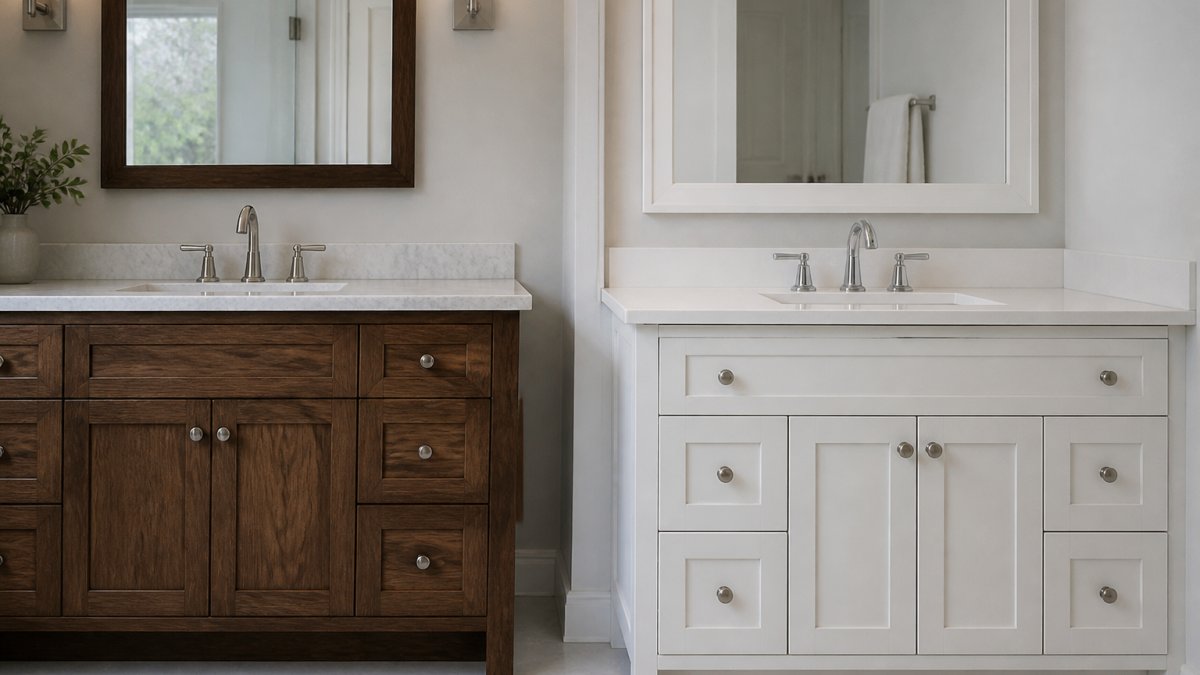
The distinction matters more in a bathroom than a kitchen.
Bathroom cabinetry is the collective term for the vanity base, upper storage, and any built-in linen or medicine storage in a bathroom. Custom versus stock affects three things: fit, wait time, and cost.
A third category, semi-custom cabinetry, uses a manufacturer's standard box sizes but lets you adjust dimensions, door styles, and finishes. Many homeowners land here once they see how far stock sizes miss their wall.
Custom vs Stock Cabinetry Comparison Table
| Factor | Stock Cabinetry | Semi-Custom | Custom Cabinetry |
|---|---|---|---|
| Sizing | Fixed standard sizes | Standard boxes, modified dimensions | Built to exact measurements |
| Best for | Tight budgets, quick timelines | Most remodels | Awkward layouts, high-end finishes |
| Lead time | In stock or days | Several weeks | Six to twelve weeks |
| Design flexibility | Limited door and finish options | More doors, finishes, sizing tweaks | Unlimited |
| Wall-to-wall fit | Gaps filled with filler strips | Close fit with some fillers | Flush, seamless fit |
| Moisture performance | Varies by material and finish | Varies | Specified per material |
The pattern is consistent: the more you pay, the more control you get over fit and finish. The question is whether your layout needs that control.
What Custom Bathroom Vanity Cost Really Looks Like
Custom bathroom vanity cost depends on size, material, door style, and interior accessories.
Those are cabinet-only figures, and cabinet price misleads homeowners most. A vanity is not usable until it has a top, sink, faucet, hardware, and plumbing connection.
Here is how the full installed cost breaks down for a typical 60-inch vanity, using common mid-range assumptions. Treat these as planning ranges, not quotes:
| Cost component | Stock / semi-custom range | Custom range |
|---|---|---|
| Cabinet box and doors | $500-$2,000 | $2,000-$6,000+ |
| Countertop (quartz or solid surface, 5 ft) | $600-$1,500 | $900-$2,500 |
| Sink (undermount or vessel) | $150-$600 | $250-$900 |
| Faucet and drain assembly | $150-$700 | $300-$1,200 |
| Cabinet and drawer hardware | $50-$250 | $150-$600 |
| Delivery and freight | $0-$250 | $150-$500 |
| Installation labor | $400-$1,200 | $700-$2,000 |
| Plumbing modifications (moving supply or drain) | $0-$800 | $300-$1,500 |
| Electrical (outlets, lighting, in-cabinet power) | $0-$500 | $200-$900 |
A stock or semi-custom vanity can land significantly higher installed once the top, sink, faucet, hardware, delivery, and labor are added.
For a like-for-like cabinet comparison, Horizon Kitchen & Bath's cabinet cost breakdown puts stock cabinets at roughly $100 to $400 per linear foot and custom cabinets at roughly $500 to $1,200 per linear foot.
Where the money goes with custom work: non-standard sizing, joinery quality, finish options, and interior fittings like drawer dividers and pull-outs.
Stock Bathroom Vanity Sizes and Where They Fall Short
Stock bathroom vanity sizes follow a short list of standard widths: 24, 30, 36, 48, 60, and 72 inches. Depths are typically 18 to 21 inches, and heights run 32 to 36 inches.
Most walls do not measure exactly. A 55-inch alcove leaves five inches of wasted space with a 48-inch stock vanity, or a cabinet that will not fit at all at 60 inches.
Stock also limits where the sink sits: it goes where the manufacturer drilled it.
Semi-custom solves most of this: manufacturers modify a standard box by a few inches in either direction, closing the gap without a full custom build.
Custom Bathroom Cabinet Lead Time and Project Sequencing
Custom bathroom cabinet lead time typically runs six to twelve weeks from final measurements to delivery; stock cabinets can arrive in days. That gap decides your project schedule more than any other factor.
Here is how we sequence a bathroom remodel so the cabinet does not hold up the trades:
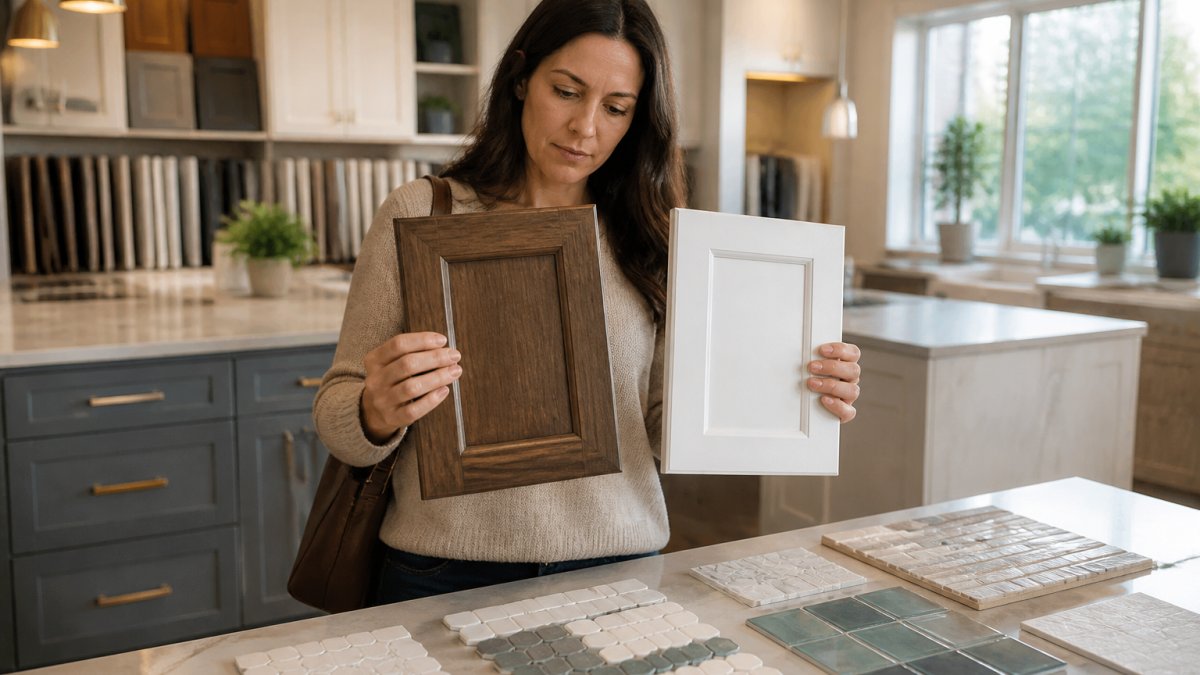
- Design and material selection. Choose tile, countertop, and cabinet finish together, not in sequence. Colors read differently against each other.
- Field measurements. Measure after demolition, not before. Old walls are rarely square.
- Cabinet order. Place the custom order as soon as measurements are confirmed.
- Rough-in work during the wait. Plumbing, electrical, and waterproofing proceed while the cabinet is being built.
- Tile and floor. Complete tile work before the vanity arrives so the cabinet sits on a finished surface.
- Cabinet delivery and installation. Set the vanity, template the countertop, then install.
- Final plumbing, hardware, and punch list.
The mistake we see most often is ordering the vanity before demolition. If the wall moves once it is opened up, the cabinet no longer fits, a vanity ordered from pre-demolition measurements can arrive an inch too wide, with no fix short of a rebuild.
Bathroom Vanity Storage Ideas That Work in Either Option
Good bathroom vanity storage ideas do not require custom cabinetry. They require planning the interior before the cabinet is ordered.
- Drawer dividers for a shallow top drawer keep toothpaste and brushes from sliding.
- A pull-out hamper in a base cabinet uses depth that shelves waste.
- An interior outlet inside a drawer or cabinet keeps a hair dryer out of sight.
- U-shaped drawers around the sink plumbing reclaim space most vanities lose.
- A tall linen cabinet to the side of the vanity adds storage without widening the counter.
- Open shelving at one end breaks up a long run of doors and holds towels within reach.
Semi-custom and custom cabinets let you specify these fittings at the factory. With stock, you add them afterward with aftermarket inserts, which works but rarely fits as cleanly.
Moisture, Materials, and How Long Each Option Lasts
How moisture actually damages a cabinet. Water reaches cabinet components three ways: direct splash, humid air condensing on cool surfaces, and leaks or slow drips at the sink and supply lines. The mechanism is almost always the same, water reaches an unfinished or poorly sealed edge, the core absorbs it, and the panel swells. Swollen particleboard and MDF never return to their original thickness; the swelling is permanent, pushing doors out of alignment and opening seams.
Core materials, ranked for a bathroom.
- Plywood holds up best among common cores. Its cross-laminated plies resist swelling better than a homogeneous core, and it recovers from minor dampness. It costs more and is heavier.
- Solid wood performs well for frames and doors when finished on all sides, but it moves with humidity and can crack at joints if the finish is incomplete.
- MDF is dimensionally stable in dry conditions and takes paint beautifully, but it swells at exposed edges and does not recover. It is fine for door faces and painted panels in a well-ventilated room, risky for the cabinet bottom and toe kick where water pools.
- Particleboard is the most moisture-sensitive common core. It is acceptable in dry zones and common in stock cabinets, but an unfinished edge near the floor or under the sink is a known failure point.
Finishes and where they fail. Thermofoil and laminate resist surface water well but can peel at seams and edges over time, especially near a shower.
The three details that decide longevity.
- Sealed edges. Every cut edge of the box, shelf, and door should be banded or sealed. This is the single most important construction detail for bathroom life, and it is where stock cabinets vary most.
- Finish coverage on all surfaces. The back of the door and the interior of the box matter as much as the front. A cabinet finished only on the face will absorb humidity from the room side.
- Ventilation. A bathroom exhaust fan sized and run correctly does more for cabinet life than an upgrade in cabinet grade. Run the fan during and for 15-20 minutes after showers, and confirm it vents outdoors, not into an attic or wall cavity.
Custom versus stock on moisture and repairability. Custom cabinetry lets you specify marine-grade plywood, full-overlay doors, moisture-resistant finishes, and sealed edges as standard, not upgrade.
Repairability is the angle most comparisons miss. A custom cabinet can often be repaired or refinished in place, and replacement doors and drawer fronts can be reordered to the same specification years later.
Choosing Your Vanity: Book a Showroom Consultation
The right answer depends on your wall measurements, timeline, and how long you plan to stay. If your wall matches a standard size and the budget is tight, stock or semi-custom is sound.
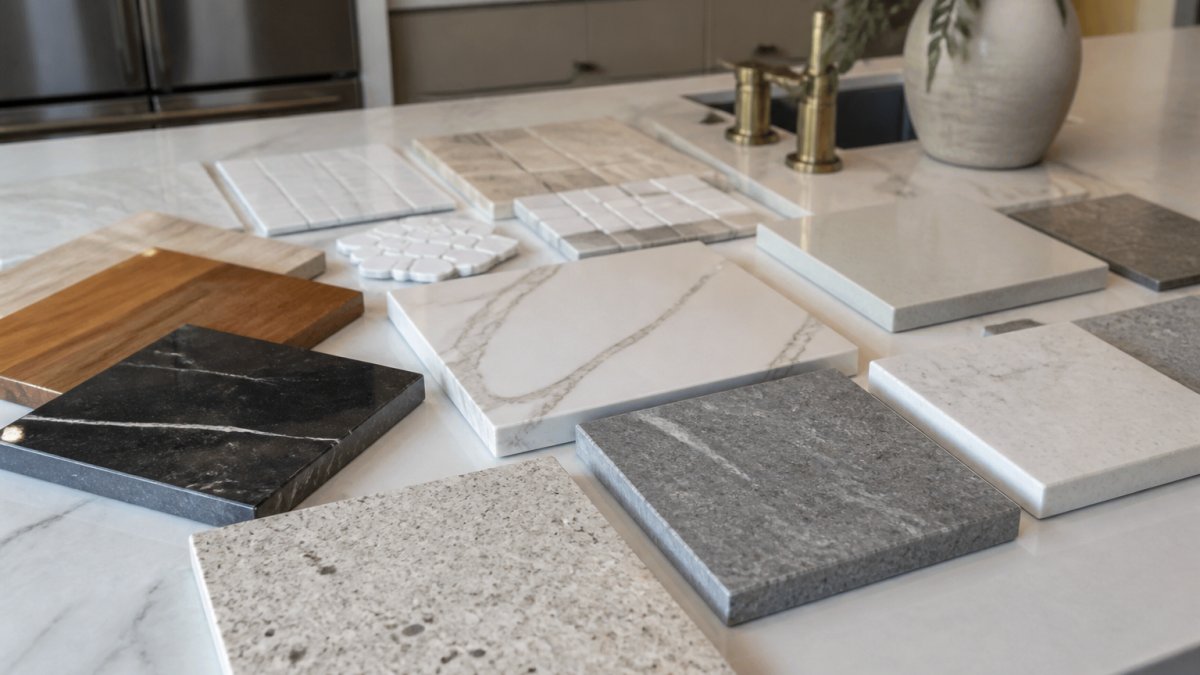
At Artisan Tile Kitchen & Bath, we walk Guilford-area homeowners through that decision in our showroom, where cabinet finishes sit beside hand-painted Moroccan zellige and Italian porcelain under natural light.
Get started with Artisan Tile Kitchen & Bath and book a showroom consultation to see how custom and stock cabinetry compare against your actual bathroom measurements.
Frequently Asked Questions
What is the difference between custom and stock cabinets?
Stock cabinets come in fixed standard sizes and a limited set of finishes, so they ship fast but often leave awkward gaps against walls. Custom bathroom cabinetry is built to your exact measurements, with your choice of door style, finish, interior layout, and hardware. Semi-custom sits between the two: standard boxes with modified sizing and more finish options. The practical difference shows up in wall-to-wall fit and how the vanity handles plumbing and outlets.
What is the average cost of custom bathroom cabinets?
Published figures vary by maker and specification. One cabinetry company lists basic custom cabinets at $1,000 to $2,500, mid-range at $2,500 to $6,000, and high-end at $6,000 to $15,000 or more. Another reports custom bathroom vanities starting around $2,000, with most around $4,000. These are cabinet-only references, so add countertop, hardware, and installation. For a project-specific quote, ask your cabinet company directly.
Are stock bathroom cabinets cheaper than custom cabinets?
Yes, usually by a wide margin. Stock cabinets are generally less expensive per linear foot than custom cabinets. The gap reflects manufacturing method: stock cabinets are made in volume to standard dimensions, while custom units are built to order. Factor in the cost of filler panels and trim needed to close gaps with stock, since those add to the total.
How long does it take to get custom bathroom cabinets?
Custom cabinets typically require six to twelve weeks from order to delivery, according to cabinetry industry sources. That window covers manufacturing, not design time or installation. Stock cabinets are usually available from retail shelves or short warehouse lead times. If your bathroom remodel has a fixed deadline, sequence the cabinet order first and schedule tile, plumbing, and countertop work around the delivery date.
Can stock bathroom vanities be modified to fit an unusual space?
Sometimes. Semi-custom lines allow modified sizing on standard cabinet boxes, which closes small gaps without full custom pricing. Stock units can also be paired with filler strips or a linen cabinet to absorb odd dimensions. But in a bathroom with sloped ceilings, offset plumbing, or a tight wall-to-wall alcove, modification options run out quickly, and custom bathroom cabinetry becomes the cleaner solution.